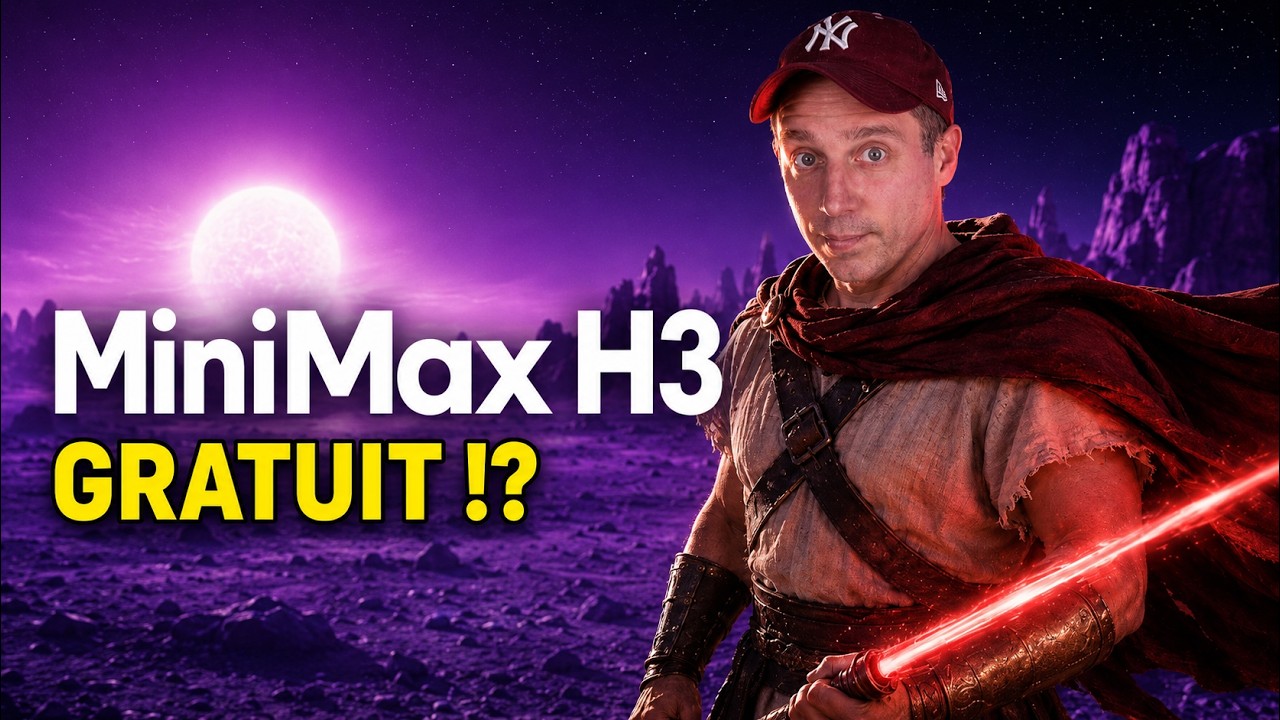
Comme promis dans ma vidéo, voici les 5 prompts que j’ai utilisés pour tester MiniMax H3, le nouveau modèle vidéo open weight de MiniMax.
Tu peux les copier tels quels et remplacer mes images de référence par les tiennes. Si tu bloques quelque part, dis-le en réponse, je te dépanne.
Avant de commencer
Où générer ? J’ai tout fait sur hailuo.video. Le générique animé, je l’ai aussi refait sur fal.ai pour éviter le watermark.
Les réglages qui comptent :
- Bien sélectionner le modèle MiniMax H3 (pas Hailuo 2.3)
- Activer Omni Reference dès que tu uploades des images de référence
- Rester en 2K, le 768p ne vaut pas le coup
- Lancer 2 générations plutôt qu’une seule quand la scène est importante. L’IA reste aléatoire, tu choisis la meilleure ou tu mixes les deux au montage
L’astuce des crédits : ouvre un compte et télécharge le Hub MiniMax, tu récupères 2000 crédits. Une vidéo de 15 secondes coûte environ 300 crédits, ça te fait 6 générations gratuites.
Sur les références : tu appelles tes images par leur numéro dans le prompt, avec l’arobase. Sur Hailuo, tu tapes @ et tu sélectionnes l’image dans la liste. C’est ce qui tient la cohérence des visages sur toute la durée du clip.
 Un point important sur la licence. Les poids de H3 sont sortis en open weight, mais la licence exclut l’Union européenne, le Royaume-Uni, la Corée du Sud et les États-Unis. Depuis la France, tu ne peux donc pas télécharger le modèle pour le faire tourner en local. En revanche l’API reste ouverte partout, donc Hailuo, le Hub et fal.ai fonctionnent normalement.
1. Le retour d’Ulysse à Ithaque
4 images de référence, 15 secondes, 2K. Ma scène préférée. Mon character sheet en image 1, puis ma femme, mon fils et ma fille. C’est le prompt qui montre le mieux ce que H3 sait faire sur la cohérence des visages et sur la synchro labiale.
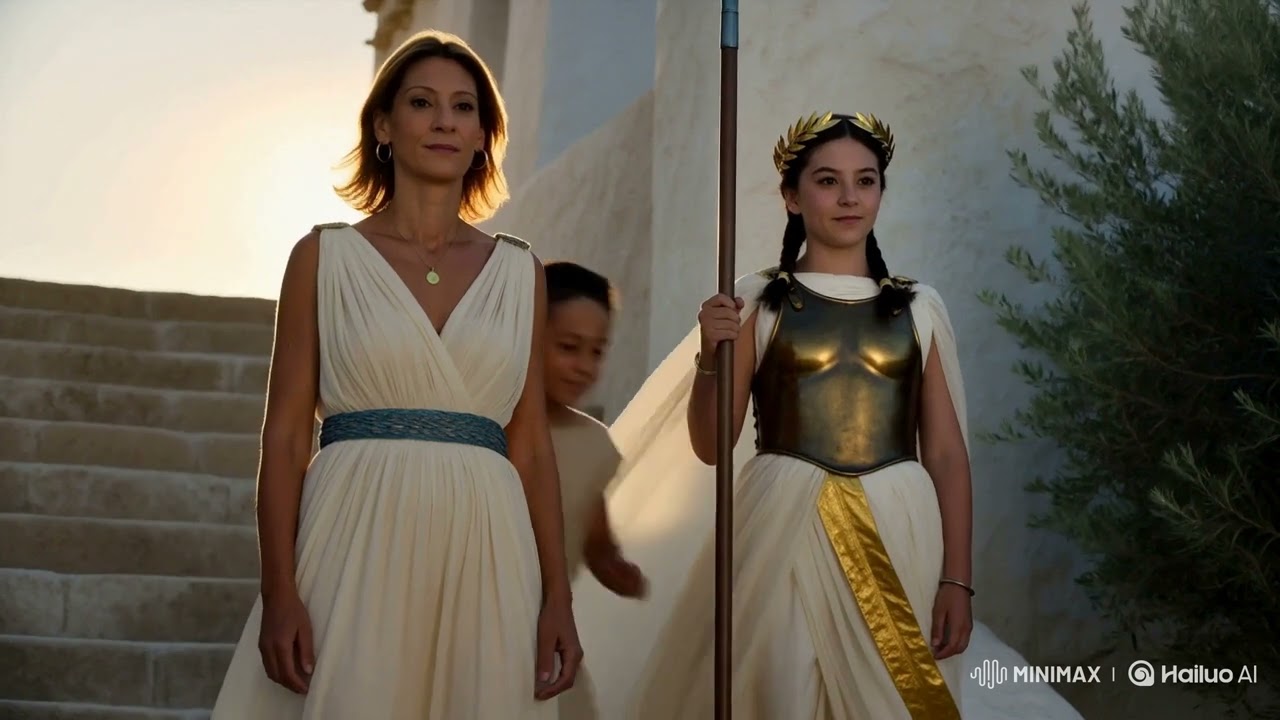
Les inputs : 1 character sheet + 3 photos de visage nettes, de face, bien éclairées.
Voir le prompt complet
REFERENCES:
- @Image1 = the hero's identity (character sheet, multiple angles). Hold his
  face, build and outfit details from this reference in every shot.
- @Image2 = the wife's identity. Woman in her 40s, shoulder-length
  copper-blonde hair, warm brown eyes, hoop earrings, calm expression.
- @Image3 = the son's identity. Boy around 10, short dark brown hair spiked
  up, tanned skin, bright smile.
- @Image4 = the daughter's identity. Teenage girl around 15, dark brown hair
  in two braids, wide smile, expressive eyes.
Hold all four faces consistent across the entire clip.

CHARACTERS:
- ULYSSE @Image1: man in his forties, weathered from years at sea. Off-white
  linen tunic with a leather chest strap, bronze arm guards, a dust-red cloak,
  leather sandals. On his head, a burgundy baseball cap with a white "NY"
  embroidered on the front — he wears it in every single shot, it never comes
  off. Salt-stained skin, three days of stubble, tired but shining eyes.
- PÉNÉLOPE @Image2: long ivory Greek chiton with a woven blue belt, hair
  loose over her shoulders, a simple gold pendant. Standing very still.
- TÉLÉMAQUE @Image3: short sand-coloured tunic, leather sandals, a small
  wooden sword hanging at his belt.
- ATHÉNA @Image4: flowing white and gold robe, polished bronze breastplate,
  golden laurel crown over her braids, a tall spear in her right hand. Serene,
  almost divine composure.

SETTING: a rocky bay on the island of Ithaca at golden hour. Turquoise water,
pale limestone cliffs, silver olive trees on the slopes, worn stone steps
climbing from the beach toward white stone houses. Warm low sun, long shadows,
dust and sea spray catching the light. Photorealistic epic cinema,
Mediterranean colour grading — warm gold, deep blue shadows.

0–3s — The Return
A wooden Greek galley glides into the bay, square sail half-furled, oars
lifting. ULYSSE stands alone at the prow, one hand on the rigging, scanning
the shore. The wind pushes his cloak back. He recognises the coastline and his
jaw tightens.
Camera: slow wide tracking shot alongside the ship, then push in to a medium
shot on his face at the prow.

3–5s — The Landing
He climbs over the rail and drops into the shallow water, wading toward the
beach with heavy steps, water up to his knees. He stops on the wet sand, looks
up at the stone steps.
Camera: low angle from the waterline, following him toward shore.

5–8s — The Family
At the top of the steps, three silhouettes appear against the sunset:
PÉNÉLOPE in the centre, ATHÉNA to her right holding her spear, TÉLÉMAQUE
half-hidden behind his mother. A long beat of silence. Then the boy breaks
away and runs down the steps.
Camera: reverse shot from behind Ulysse, revealing the three figures, then cut
to a medium shot on the family.

8–11s — Télémaque
The boy runs full speed across the sand and throws himself into his father's
arms. Ulysse catches him and lifts him off the ground, laughing, eyes closed.
TÉLÉMAQUE (French, child's voice, breathless with joy): « Père ! Tu es
revenu ! »
ULYSSE (French, low and hoarse, close to tears): « J'ai traversé toutes les
mers pour vous. »
Camera: handheld medium shot circling the two of them.

11–13s — Pénélope
She walks down the last steps and stops in front of him. She lifts a hand to
his face, slowly, as if checking he is real.
PÉNÉLOPE (French, quiet, steady, twenty years of waiting in her voice):
« Vingt ans, Ulysse. Vingt ans. »
He covers her hand with his own. They embrace, the boy still clinging to his
side.
Camera: slow push-in to a tight two-shot.

13–15s — Athéna
ATHÉNA descends last, plants her spear in the sand and smiles at her father.
ATHÉNA (French, warm and clear): « Papa, bienvenue chez toi. »
Camera pulls back and rises into a wide aerial shot: the four of them together
on the beach, the galley anchored in the bay, olive slopes and white houses
behind, the sun touching the horizon. Freeze on the wide.

AUDIO (native stereo, generated with the picture):
- Ambience: waves breaking on rock, wind in the rigging, wood creaking, gulls
  in the distance, sandals on wet sand.
- Foley: the splash as he drops into the water, the boy's running footsteps,
  the spear butt striking the sand at 13s.
- Dialogue: all lines in French, intimate and close-miked, never shouted.
- Score: a single low string drone from 0s, a solo lyre entering at 8s, full
  warm strings swelling from 11s and resolving on the wide shot at 14s.
- Keep the score silent between 5s and 8s — only wind and waves during the
  moment of recognition.

CONSTRAINTS:
- 16:9, photorealistic epic cinema throughout, no stylisation or animation.
- All four faces fully visible and consistent with Images 1 to 4.
- The burgundy NY cap stays on the hero's head in every shot, including the
  landing in the water and the embrace.
- No modern objects, no brand names, no logos anywhere in frame apart from the
  cap.
- Natural performances, no theatrical over-acting.
2. Ulysse contre le Cyclope et Poséidon
1 image de référence, 15 secondes, 2K. Deux décors, deux répliques, et une scène d’action. C’est là que H3 montre ses limites : les mouvements sont moins naturels que sur Seedance, et l’œil du cyclope se rallume après le coup de pieu chez moi. En revanche la synchro labiale sur la deuxième réplique est parfaite.
Voir le prompt complet
REFERENCES:
- @Image1= the hero's identity (character sheet, multiple angles). Hold his
  face, build and outfit details from this reference in every shot.

CHARACTERS:
- ULYSSE @Image1: man in his forties, lean and weathered. Off-white linen
  tunic with a leather chest strap, bronze arm guards, a dust-red cloak,
  leather sandals. On his head, a burgundy baseball cap with a white "NY"
  embroidered on the front — he wears it in every single shot, it never comes
  off, not during the fight, not during the storm. Soot on his face, three
  days of stubble, fierce determined eyes.
- THE COMPANIONS: four Greek sailors in rough tunics and leather belts,
  muscular, bearded, faces smeared with ash. They act as one with Ulysse.
- THE CYCLOPS: a colossal giant, five metres tall, roughly four times the
  height of a man — the size contrast must be obvious in every frame he
  appears in. Massive muscular torso, rough grey-brown skin, matted black hair
  and beard, wearing crude animal hides. CRITICAL: he has exactly ONE SINGLE
  EYE, one large round eye centred in the middle of his forehead. He has NO
  other eyes. No second eye, no third eye, no eyes on the sides. One eye only,
  in the centre of the forehead, above the nose. This is the single most
  important physical detail of the character.
- POSÉIDON: a colossal figure rising out of the sea, forty metres tall, his
  body formed of churning black water and white foam. Long streaming beard,
  crown of coral, a huge bronze trident in his right hand. Ancient, furious,
  elemental.

SETTING 1 (0 to 6s): the interior of a vast rocky cave, lit only by a low fire.
Bones and crude clay jars on the ground, a huge boulder blocking part of the
entrance. Deep shadows, orange firelight, drifting smoke and dust.
SETTING 2 (6 to 15s): a rocky Mediterranean shore at dusk, then open sea under
a black storm sky. Towering waves, lashing rain, forked lightning.
Photorealistic epic cinema, Ridley Scott colour grading — warm gold in the
cave, cold blue-black at sea.

0–3s — Mon nom est Personne
Wide low-angle shot inside the cave. ULYSSE stands small in the frame at the
bottom of the shot. Towering above him, seated against the rock wall, THE
CYCLOPS looms — his single central eye catching the firelight, blinking slowly.
Ulysse looks straight up at him, hands calmly behind his back, completely
still.
ULYSSE (French, calm, level, almost amused): « Mon nom est Personne. »
The giant's one eye narrows.
Camera: low angle from behind Ulysse's shoulder, emphasising the four-to-one
height difference.

3–6s — Le pieu
Ulysse and his FOUR COMPANIONS seize a long olive-wood stake, its tip glowing
white-hot from the fire. They charge forward together, roaring, and drive the
burning point up into the giant's single central eye. A blinding white flash
fills the frame, sparks and thick smoke burst outward. The Cyclops rears
backward, both hands clamped over his forehead, and lets out a deafening roar
that shakes dust from the cave ceiling. No blood, no gore — the impact is told
through light, smoke and the giant's recoil.
Camera: fast tracking shot travelling with the stake, hard cut to a wide shot
of the giant staggering back against the rock wall.

6–9s — La fuite
The men sprint out of the cave into the dusk. They run down a rocky slope
toward the shore where a wooden Greek galley waits in the shallows, sail
already dropping. They shove the hull off the sand and haul themselves aboard.
Ulysse leaps onto the deck last, cloak flying behind him.
Camera: handheld running shot behind the group, then a wide shot of the galley
pulling away from the shore.

9–11s — Le message
On the deck, the galley now clear of the rocks, ULYSSE turns back toward the
island, cups his hands around his mouth and shouts across the water, grinning.
ULYSSE (French, shouted, cocky, full of bravado): « Dis à Poséidon que
Jeanviet l'embrasse ! »
Behind him his companions laugh and raise their oars. On the distant shore,
the blinded giant's silhouette staggers against the sky.
Camera: medium shot on Ulysse at the stern, sea and island behind him.

11–15s — La colère de Poséidon
The sky turns black in an instant. Rain lashes down, lightning splits the
clouds. The sea rises. Behind the galley, POSÉIDON erupts out of the water,
forty metres of black water and foam, and slams his bronze trident down onto
the surface. A colossal wave rears up and tilts the ship almost vertical.
Ulysse grips the mast with one hand and holds his cap onto his head with the
other, shouting into the storm as the wall of water closes over the frame.
Camera: chaotic handheld shots on the deck, then a wide shot of the tiny ship
against the god and the wave. Cut to black on impact.

AUDIO (native stereo, generated with the picture):
- Cave (0 to 6s): crackling fire, dripping water, the giant's heavy breathing,
  a low sub-bass rumble under everything.
- Impact (3 to 6s): wood splitting, a searing hiss, then the giant's roar
  filling both channels.
- Shore (6 to 9s): running footsteps on gravel, hull scraping sand, oars
  striking water, men shouting orders in the distance.
- Sea (11 to 15s): rising wind, torrential rain, thunder cracks, the deep
  groan of the trident striking the water, timbers creaking.
- Dialogue: both lines in French. The first line intimate and close-miked, the
  second shouted across open water with natural reverb.
- Score: silence from 0 to 3s, low percussion building from 3s, full brass and
  drums from 11s, cutting dead on the final impact.

CONSTRAINTS:
- 16:9, photorealistic epic cinema throughout.
- The hero's face fully visible and consistent with Image 1 in every shot.
- The burgundy NY cap stays on his head in every shot, including the charge
  and the storm.
- THE CYCLOPS HAS EXACTLY ONE EYE, centred in the middle of his forehead.
  Never two eyes, never three eyes. One single central eye.
- The Cyclops must read as a giant, at least four times the height of a man,
  in every frame where he appears.
- No blood and no gore at any point. The stake impact is rendered with light,
  smoke and recoil only.
- No modern objects, no brand names, no logos anywhere apart from the cap.
Le détail à retenir : j’insiste trois fois sur le fait que le cyclope n’a qu’un seul œil, dans la description du personnage et dans les contraintes. Sans ça, le modèle lui en colle deux systématiquement. Même logique pour la casquette.
3. Le duel père contre fils sur Mars
2 images de référence, 8 secondes, 2K. Un clin d’œil à Star Wars avec mon fils, sabres laser rouge et bleu, sur Mars. C’est le prompt le plus court et le plus efficace des cinq, parce qu’il ne raconte qu’une seule chose.
Voir le prompt complet
REFERENCES:
- @Image1 = the father's identity (character sheet, multiple angles). Hold his
  face and build from this reference in every shot.
- @Image2 = Jonathan's identity. Boy around 10, short dark brown hair spiked
  up, tanned skin, determined expression.
Hold both faces consistent across the entire clip.

CHARACTERS:
- THE FATHER @Image1: man in his forties, lean and weathered. Off-white
  linen Greek tunic with a leather chest strap, bronze arm guards, a dust-red
  cloak, leather sandals. On his head, a burgundy baseball cap with a white
  "NY" embroidered on the front — it stays on in every shot, including when he
  falls. He wields a glowing RED energy sword in his right hand.
- JONATHAN @Image2: boy around 10, wearing a short sand-coloured Greek
  tunic, a small leather belt, leather sandals, a thin bronze circlet in his
  hair. He wields a glowing BLUE energy sword, held two-handed. Small but
  fearless, feet planted wide.

SETTING: the surface of Mars at dusk. Rust-red sand and gravel, jagged dark
rock formations, a vast dust-hazed horizon, the pale sun low and small in a
deep amber sky. Two moons faintly visible. Fine red dust drifting through the
air, kicked up by every step. Photorealistic epic cinema, high contrast — the
red and blue blades are the only saturated colours in an otherwise rust-toned
frame, casting coloured light onto the sand and onto both faces.

0–2s — Face à face
Wide low-angle shot. Father and son stand ten metres apart on the red plain,
blades already ignited — red on the left, blue on the right. Cloaks and dust
moving in the thin wind. They both step forward into guard position.
Camera: slow lateral tracking shot passing between them, red light on one side
of frame, blue on the other.

2–4.5s — Le duel
They charge and clash. Red and blue blades meet in a shower of sparks, three
fast exchanges — the father attacking high, the boy parrying and holding his
ground, sand exploding under their feet. The boy is smaller and faster, ducking
under a wide swing.
Camera: handheld, fast, circling the two fighters, camera shake on each impact.

4.5–6.5s — La chute
Jonathan swings low and sweeps his father's leading leg. The father loses his
footing and falls hard onto his back in the red sand, his red blade skidding
out of reach. Dust bursts up around him. The boy steps forward and levels the
blue blade at his father's chest, breathing hard, blue light on his face.
Camera: low angle from ground level as the father falls, then reverse to a low
shot looking up past the blue blade at the boy standing over him.

6.5–8s — La révélation
Close-up on the father lying in the sand, propped on one elbow, cap still on,
red dust on his face, looking up at his son. He is not afraid. He almost smiles.
THE FATHER (French, low, calm, heavy with meaning): « Je suis ton père,
Jonathan. »
The boy's eyes widen. The blue blade wavers slightly. Hold on his stunned face.
Cut to black.
Camera: tight close-up on the father for the line, then cut to a tight
close-up on the boy's reaction.

AUDIO (native stereo, generated with the picture):
- Ambience: thin high wind across open ground, fine sand hissing over rock,
  a hollow low-pressure atmosphere with almost no reverb.
- Foley: the deep hum of both energy blades, rising in pitch as they swing,
  a hard electric crack on each clash, sandals sliding in gravel, the heavy
  thud of the father hitting the ground, dust settling.
- Dialogue: the final line in French, close-miked, quiet, unhurried.
- Score: silence from 0 to 2s except wind, low percussion and a rising drone
  from 2s through the duel, everything dropping to near-silence at 6.5s so the
  line lands bare, a single low brass note on the cut to black.

CONSTRAINTS:
- 16:9, photorealistic epic cinema throughout.
- Both faces fully visible and consistent with Images 1 and 2.
- The father's blade is RED, the son's blade is BLUE. Never swap them.
- The burgundy NY cap stays on the father's head in every shot, including the
  fall.
- Greek tunics and sandals on both characters — no armour, no modern clothing,
  no space suits or helmets despite the Martian setting.
- No blood, no injury. The father is knocked down, not wounded.
- No brand names or logos anywhere apart from the cap.
4. Le trucage video to video
1 vidéo source, 11 secondes. Celui-ci ne part pas d’une image mais d’une vidéo de moi qui parle face caméra. Je garde ma tête, mes gestes, ma voix et ma synchro labiale, et je change le décor et les vêtements en cours de plan.
Deux choses à faire avant de le lancer : relever le timecode où tu veux la transition (Xs) et celui où le texte doit apparaître (Ys), puis les remplacer dans le prompt. Et bien citer ta vidéo avec @Video1, sinon le modèle l’ignore.
Note : cette version est condensée pour tenir sous la limite de caractères des interfaces API.
Voir le prompt complet
@Video1 = source footage. A man speaking to camera in French. Keep his face,
his head movements, his hand gestures, his lip sync and the original audio
exactly as they are. Do not change the framing, the timing or the performance.

CONSTANT ACROSS THE WHOLE CLIP:
The burgundy baseball cap with the white "NY" on the front stays on his head
in every single frame, in both shots, unchanged in shape and colour. It never
comes off and is never replaced by a helmet, a headband or a crown.

SHOT 1, 0s to Xs, DATACENTER
Keep his real clothes from the source footage, unchanged. Replace only the
background: the interior of a modern datacenter, a long aisle of black server
racks, blue and white LEDs blinking, cold cyan key light from his left,
cabling overhead, faint haze. Shallow depth of field, racks receding out of
focus behind him.

TRANSITION at Xs
One fast whip blur, a single frame of motion. No dissolve, no morph. The
wardrobe change and the location change happen together on this blur.

SHOT 2, Xs to end, THE SHIP
His clothes are now an Ulysses warrior outfit: off-white linen tunic, brown
leather chest strap, bronze arm guards, dust-red cloak over one shoulder.
Light stubble, salt-worn skin. Background: the deck of a wooden Greek galley
at sea, golden hour. Square linen sail behind him catching the wind, rigging
ropes, worn planks, turquoise Mediterranean water, a distant coastline. Warm
low sun from the right, sea spray in the light, his cloak moving in the wind.

TEXT MOMENT at Ys
He raises both hands in front of his chest and the word "Jeanviet" appears
between them in clean white sans-serif capitals, sharp and legible, faint
glow, no drop shadow, no box. It holds until the end of the clip. Spelling
exactly: Jeanviet

AUDIO: keep the original recording untouched, voice and lip sync unchanged.
Add ambience underneath only: low server hum in shot 1, wind and waves in
shot 2.

CONSTRAINTS: photorealistic, no stylisation. Same person, same voice
throughout. His clothes must be identical to the source footage for the whole
of shot 1. No logos or brand marks anywhere except the NY cap and the word
Jeanviet. No subtitles.
Deux points de vigilance. La ligne qui répète que les vêtements du shot 1 doivent rester identiques à la source est indispensable : sans elle, la tenue d’Ulysse déborde sur tout le clip. Et cale ton Xs sur un temps faible de ta phrase, sinon la coupe passe pour un bug.
5. Le générique animé de chaîne
1 character sheet + 1 logo + 1 piste audio, 10 secondes. Celui-là fonctionne complètement différemment : je donne un audio et je demande au modèle de le traiter comme une timeline de montage. Chaque coupe tombe sur un temps.
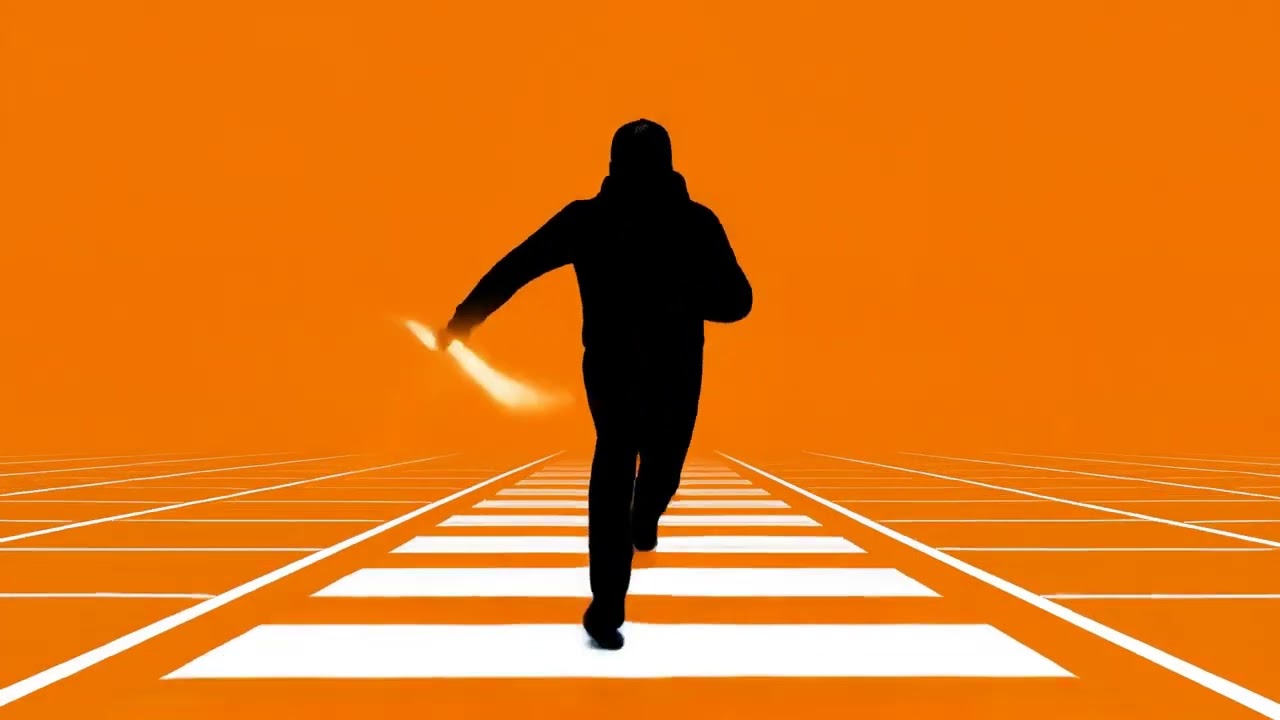
Inspiré d’un post de @AIWarper sur X, que j’ai adapté à ma charte graphique. La musique est générée avec ElevenLabs, mais Suno marche aussi.
Si tu le reprends, remplace la palette de couleurs, le texte du titre et le tempo par les tiens.
Voir le prompt complet
Using the attached character sheet for the character and the attached logo for branding, and the attached audio track for timing, generate a 10 second cyber pop-art title sequence for a tech and AI YouTube channel. Every cut must land exactly on a beat of the audio: treat the track as the edit timeline. Tempo is approximately 130 BPM (one beat every 0.46 s, one bar every 1.85 s).

VISUAL STYLE, apply throughout:
Render the character as a flat, high contrast black silhouette against solid single color backgrounds. Strict palette, no other colors allowed: electric blue #2C8DCB, bright orange #F77A02, pure white #FFFFFF, deep black #000000. Each shot commits to one background color plus one accent, like a screen printed poster. Note: the attached logo is supplied on a green chroma key background. Ignore the green entirely, it is not part of the palette.

Keep the silhouette faithful to the character sheet: baseball cap with a curved visor worn straight, zip up hoodie, straight jeans, running shoes, lean athletic build. The cap is the signature shape and must stay readable in every profile shot.

Compose shots like comic book panels: bold panel divisions splitting the frame, hard geometric shapes, dramatic off center cropping, extreme close ups intercut with full body poses.

Setting is a futuristic city at night reduced to pure graphic elements: flat neon skyline shapes, receding perspective grids, glowing horizontal light streaks, concentric arcs echoing the sound wave mark in the logo.

The character carries a glowing energy blade emitting orange #F77A02 light. In several shots the blade is the only light source. It doubles as a graphic device: a long light trail behind the sprint, a slash that wipes the frame, and finally a horizontal bar under the title.

Freeze frames are a core device: the character hits a dynamic pose (mid sprint, blade ignition, slash follow through, turning toward camera) and the frame HOLDS completely still for one full beat before cutting. Do not smooth or interpolate through these holds, they must be dead stops.

Typography in mid century Saul Bass style: stark geometric bold sans serif, white with a hard black drop shadow, sliding in as flat colored bars or snapping into frame on the beat.

Overlay the whole sequence with analog texture reinterpreted as cyber: fine horizontal CRT scanlines, subtle chromatic aberration on the orange edges, slight gate weave, faint print grain. It should look like a screen printed cyberpunk poster in motion, not clean 3D animation.

MOTION AND EDITING:
Alternate two modes: (1) fast kinetic bursts (whip pans across the silhouette, a silhouette sprinting across a solid color field, neon streaks flying past) and (2) hard freeze frame holds. The contrast between the two IS the rhythm. Hard cuts only: no dissolves, no fades, no morphing. Each new shot snaps in on the downbeat with a fresh background color, cycling blue, orange, white, black.

SHOT LIST, cut exactly on these timecodes:
0.00 Extreme close up, black silhouette of the capped head in profile against solid orange, an orange glow rising along the eye line. HOLD.
0.93 Full body, silhouette sprinting left to right across a flat blue field, flat neon skyline shapes scrolling behind. FAST.
1.85 Low angle on solid white, the silhouette skids to a stop and ignites the blade, an orange light bar shooting up the frame. FREEZE on ignition.
2.78 Whip pan across a black field crossed by orange light streaks, the silhouette entering frame at the last instant. FAST.
3.71 Split panel: three vertical panels, blue, orange, white, the same silhouette in a different pose in each. FREEZE.
4.64 Extreme close up on the hand gripping the blade, orange rim light on black. HOLD.
5.56 Silhouette sprinting straight toward camera on a receding orange perspective grid, blade trailing a long light streak. FAST.
6.49 Slash: the blade sweeps across the frame and the stroke wipes the image to a solid blue field. FREEZE at the end of the slash.
7.41 Wide shot, silhouette standing centered on solid orange, blade held low, concentric white sound wave arcs expanding from the body. FREEZE.
8.34 Cut to solid blue. The title snaps in on the beat: JEANVIET in bold white geometric caps with a hard black drop shadow, and below it L'IA POUR TOUS in white inside a solid orange rounded pill bar, matching the attached logo. The energy blade lies horizontally under the title as an orange bar.
9.26 Final hit: the frame holds dead still on the title card while a single white circular sound wave pulse expands once from behind the text, then cut to black.
Chez moi, le fond vert du logo est resté sur une génération malgré la consigne. Si ça t’arrive, mets ton logo sur fond noir plutôt que vert.
Les 3 règles qui font la différence
1. Découpe ta scène seconde par seconde. Ce n’est pas une description, c’est une timeline. Tu verras que mes cinq prompts fonctionnent tous pareil : des blocs de temps, et dans chaque bloc ce qui se passe plus le mouvement de caméra. C’est ce que le modèle attend.
2. Répète tes contraintes visuelles. Tout ce qui doit absolument tenir sur la durée du clip apparaît deux fois : une fois dans la description du personnage, une fois dans le bloc CONSTRAINTS à la fin. La casquette, l’œil du cyclope, la couleur des sabres. Une seule mention ne suffit pas.
3. Écris ta section audio séparément. Comme le son est généré dans la même passe que l’image, plus tu le décris, meilleure est la synchro. Sépare ambiance, bruitages, dialogues et musique, et donne les timecodes des changements. C’est ce qui fait la différence entre une vidéo IA et une scène de film.
Pour écrire tes prompts, ma méthode : je donne le guide de prompting officiel MiniMax à Claude, je lui décris ma scène en français, et il me sort la version structurée en anglais.
Tu as testé ? Poste tes vidéos et tes prompts en réponse, je suis curieux de voir ce que ça donne sur d’autres univers que la Grèce antique 